
Cellular respiration is one of those topics that requires the perfect blend of teaching, visualizing, and yes—memorizing.
Students need repeated exposure to the stages and a lot of practice before the whole process really clicks. Here’s the sequence I’ve refined over years of teaching, along with resources that support each piece of instruction.
1. Start With Direct Instruction
I open the unit with a simple, introductory PowerPoint. The first learning target we tackle is:
“I can describe the inputs and outputs of cellular respiration.”
During this first week, my main goal is for students to confidently identify what goes into each stage of the process and what comes out. After the PowerPoint overview, students complete an introductory reading for homework to reinforce the big picture.
2. Move Into Models and Visual Notes
Once students have basic background knowledge, I start bringing the process to life.
We work through a POGIL-style activity to examine each stage more deeply—especially the inputs and outputs. Then we transition into color-coded notes, which help students make sense of the flow of molecules and energy.
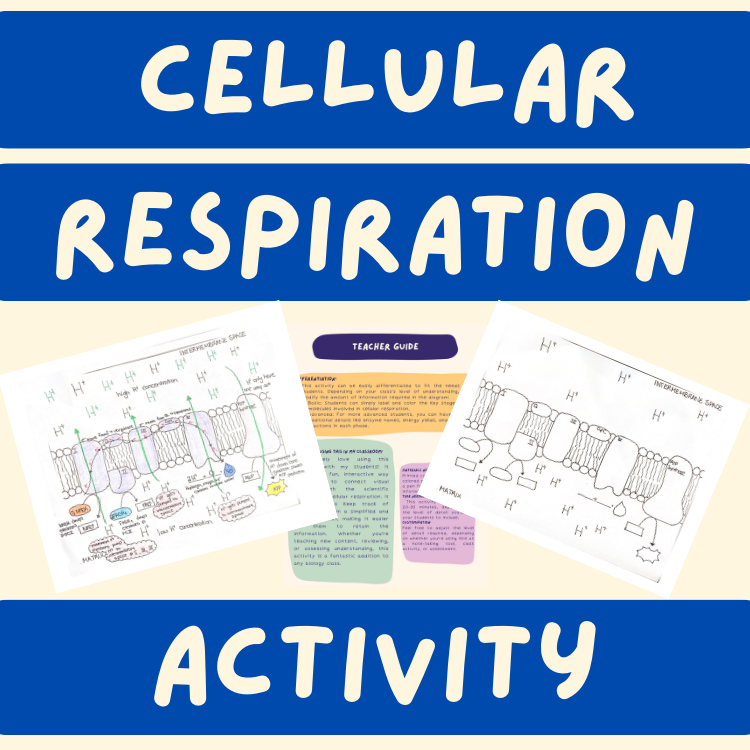
At this point, we shift to our second learning target:
“I can explain what occurs in each of the stages of cellular respiration.”
After color notes, students read a more in-depth passage that breaks down glycolysis, the Krebs cycle, and the ETC.
(The reading I use is on my TPT store if you want a scaffolded option.)
3. Let Students See the Moving Pieces
Now that students understand the structure of the process, they’re ready to see it in action.
I use the Bioman Cellular Respiration simulation with an accompanying worksheet. This simulation is incredibly helpful because students can visually track how ATP, NADH, and FADH₂ are created. It also shows the movement of electrons through the ETC, which is normally one of the hardest concepts for students to grasp.
4. Apply Their Knowledge
By this point, students should have a solid understanding of the entire process—so it’s time to apply what they’ve learned.
Options I love:
- A simple yeast fermentation lab to observe outputs
- Online respiration labs
- A real-world case study
(I have a classroom-tested case study in my TPT store that walks students through applying their new knowledge in a real-life scenario.)
Application activities push students from memorizing to actually using the concepts.
5. Review and Assess
Before wrapping up the unit, we do a structured review. Students attempt to fill in the color notes without using their notebooks—a great way to gauge how much they’ve internalized.
Next, we use task cards for collaborative review.
(If you’re looking for easy prep, my cellular respiration task card set is ready to go in my TPT store.)
Finally, students complete a short quiz to demonstrate mastery.
(I also have this quiz available on my TPT store if you need a student-friendly version.)
Conclusion
Teaching cellular respiration effectively is all about giving students multiple, varied interactions with the same core concepts. When students see the process through notes, models, readings, simulations, labs, and applications, the content sticks—and their confidence grows.If you want to try the exact materials I use, you can explore my Cellular Respiration Bundle on my TPT store, or grab individual resources that fit your classroom needs.