Teaching DNA is genuinely one of my favorite units of the year.
The content is fascinating, the visuals are strong, and there are so many ways to bring the concepts to life. Over time, I’ve developed a classroom flow that blends direct instruction, inquiry, and science and engineering practices (SEPs)—ensuring students learn the material and deeply understand why it matters.
Below is my step-by-step process for teaching DNA structure and function, along with ideas, visuals, and activities you can incorporate right away.
Key notes
- A structured teaching flow—visual notes, DNA models, reading passages, and practice—helps students master DNA structure and DNA replication with confidence.
- Hands-on DNA modeling and color-coded diagrams make complex biology concepts easier to understand and improve student engagement in the science classroom.
- Incorporating science literacy through annotated readings strengthens vocabulary, comprehension, and overall understanding of how DNA structure connects to the process of replication.
Start with Discovery: The HHMI Video
I always open this unit with the HHMI video (LINK). It’s the perfect way to reinforce that science is collaborative and that our understanding of DNA came from years of investigation and shared ideas. Students complete the accompanying worksheet as they watch, which helps them connect the discoveries to the structure we study today.
Once they see the “story” of DNA, we’re ready to dive into the details.
Color-Coded DNA Structure Notes
After students understand the big picture, we move into color/doodle notes, which are one of my favorite strategies for teaching microscopic or abstract concepts. I have a full set of DNA Structure & Replication Color Notes in my TpT store if you want a ready-to-go version.
During this section, we focus on:
- The sugar-phosphate backbone
- The nitrogenous bases
- Base-pairing rules
- Purines vs. pyrimidines and hydrogen bonding—depending on your class level
Color coding helps students visualize the pattern and symmetry of the molecule while reinforcing vocabulary.
Build DNA With Classroom Models
Before we jump into DNA replication, I have students build DNA models. This is where the structure finally “clicks.” Over the years, I’ve used:
- Pipe cleaners + beads
- Candy models
- Cut-and-match paper pieces
- 3D printed sets
- Digital drag-and-drop activities
The goal is simple: help students visualize the double helix and truly understand the complementary nature of the strands.
Science Literacy: DNA Reading Passage Work
Once students can see DNA, we shift into science literacy—an SEP I think we all could incorporate more often. Students read a passage (I have one available in my TpT store) that introduces the concept of DNA replication.
As they read, I have them:
- Annotate
- Highlight vocabulary
- Mark steps of the process
- Write margin notes
If your students haven’t been taught how to annotate, model it with them. It turns reading into an active and purposeful learning experience.
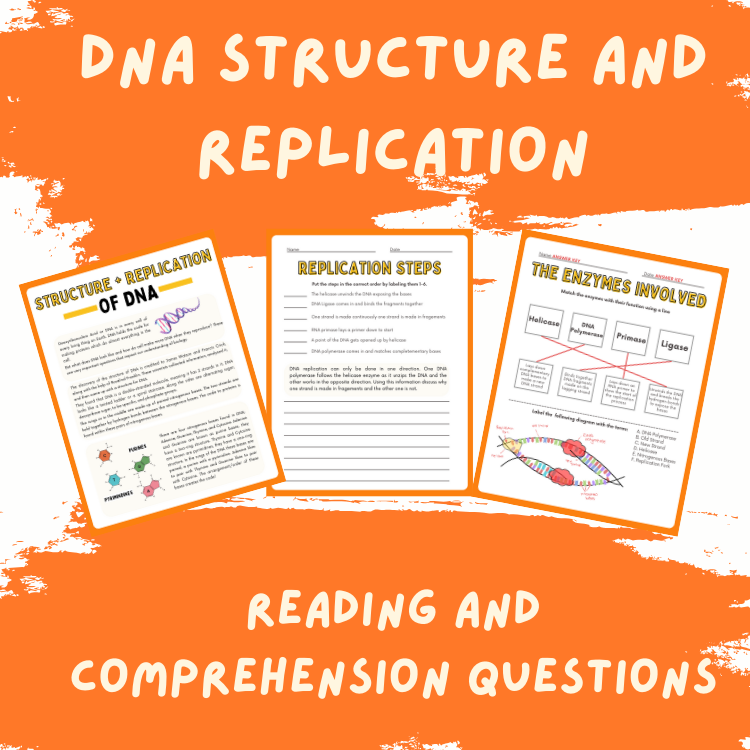
After reading, we return to our color notes and walk through DNA replication together—emphasizing enzymes, sequence of steps, and the base-pairing rule.
Practice the Base-Pairing Rule (Repetition Is Everything!)
Now it’s time for hands-on practice. Repetition is key when teaching DNA replication, and I love to mix structured tasks with creative activities.
Some of my favorite reinforcement activities:
- Drawing models on desks without notes, then checking for accuracy
- “Heads Up” vocab game (using bases, enzymes, and key terms)
- Matching games (available in my TpT store)
- Practice task cards (also in my store!)
Pull It All Together With a Quick Check-In
Finally, we assess. It doesn’t need to be formal—just something that allows students to show what they know. You might use:
- A short quiz (there’s one in my TpT store)
- A sketch-note prompt
- A written explanation or model-building check
Assessment can be flexible—you know your students and what will help them best demonstrate understanding.
Final Thoughts
This sequence—visual notes → models → literacy → practice → check-ins—provides multiple pathways for students to master the concepts behind DNA structure and replication. Even struggling learners walk away with a strong understanding of how DNA’s structure makes accurate replication possible.
If you want to try the exact tools I use, the DNA Structure & Replication Color Notes, Reading Passages, and Practice Resources are all available in my TpT store and fit seamlessly into this teaching flow.